Outcome-Based Education + DASH AI
Make outcomes the operating system of learning.
Move from a syllabus and isolated marks to a connected OBE practice—where course outcomes shape content, teaching, assessment, evaluation, attainment and every improvement that follows.
- CO Course-level alignment
- PO Programme-level attainment
- CQI Continuous quality improvement
OBE command centreB.Tech · Computer Science
Academic year 2026–27Programme outcome healthEvidence you can act on
Live course dataCO attainmentTarget 70%
Low application-level performance in Trees and Graphs.
View suggested action →Syllabus→COs→Learning→Assessment→Attainment→Action
OBE as everyday practice
Not a reporting exercise.
A better way to teach.
Outcome-Based Education begins with what learners should be able to demonstrate. TriByte keeps that intent visible from curriculum design to the classroom—and connects it to the evidence used for review.
Start with measurable outcomes
Define clear COs and align them with Bloom’s taxonomy, POs, PSOs and the competencies your programme values.
Intent before activityDesign backwards from evidence
Connect learning material, activities, questions and rubrics to the outcomes they are meant to develop and demonstrate.
Alignment before deliveryClose the loop continuously
See where learners are struggling, record action taken and measure whether the next cycle actually improved attainment.
Improvement after insightOne connected OBE journey
From educational intent to demonstrable impact.
TriByte carries the outcome context through every stage, so faculty do not have to rebuild the same mappings and evidence in separate tools.
- 01Plan
Define the outcome framework
Bring Vision, Mission, PEOs, POs and PSOs into the programme structure. Draft or refine measurable COs from the syllabus and classify them by cognitive level.
- CO authoring and review
- Bloom’s taxonomy tagging
- CO–PO/PSO mapping
Outcome statementCO3Apply tree and graph structures to solve computational problems.
Apply · L3PO1 · PO2 · PSO1 - 02Teach
Align curriculum, content and activity
Plan units, sessions and learning resources against COs. Keep live, blended and self-paced delivery connected to the same outcome structure.
- Lesson and unit planning
- Outcome-aligned resources
- Projects, practicals and assignments
Aligned learning planUnit 3 · TreesCO3Unit 4 · GraphsCO3 · CO4Applied labCO4 - 03Measure
Assess what the outcome asks for
Build blueprints, question banks and rubrics that reveal the right knowledge and skills—not just syllabus coverage. Capture objective, subjective and applied work.
- CO and Bloom’s-level blueprints
- Rubric-led evaluation
- Direct and indirect evidence
Assessment blueprintRemember20%Apply50%Analyse30%Coverage check Balanced
- 04Understand
Calculate attainment with traceability
Apply the institution’s approved methodology and targets. Move from student evidence to CO attainment, then roll contributions up to POs and PSOs.
- Threshold and target configuration
- CO and PO/PSO attainment
- Cohort, course and programme views
Attainment snapshot2.6of 3.0CO3 attained Target met
- 05Improve
Turn gaps into documented action
Identify weak outcomes and affected learner groups, assign corrective action, track follow-through and preserve the evidence for the next programme review.
- Gap and root-cause review
- Action ownership and status
- Cycle-over-cycle evidence
Continuous improvement logCO3 · Application gapIn progressAdd worked graph problems and a targeted lab before Assessment 2.
AI Content Studio for faculty
Give faculty time back for teaching, mentoring and review.
Faculty can research a topic, bring approved source material into AI Content Studio and ask DASH AI to build the first version—grounded in that material and aligned to the course context.
Bring the evidence
Upload papers, PDFs, documents, links, videos and existing course material.
Set the learning intent
Select COs, learner level, format, language, depth and instructional goal.
Generate the first draft
Create structured notes, beautiful presentations, summaries, examples and questions.
Review and publish
Faculty edits, approves and keeps academic control before students see anything.
⌁
Where time is savedLess repetitive formatting, copy-paste and first-draft production—more time for validation, contextual examples, feedback and learner support.
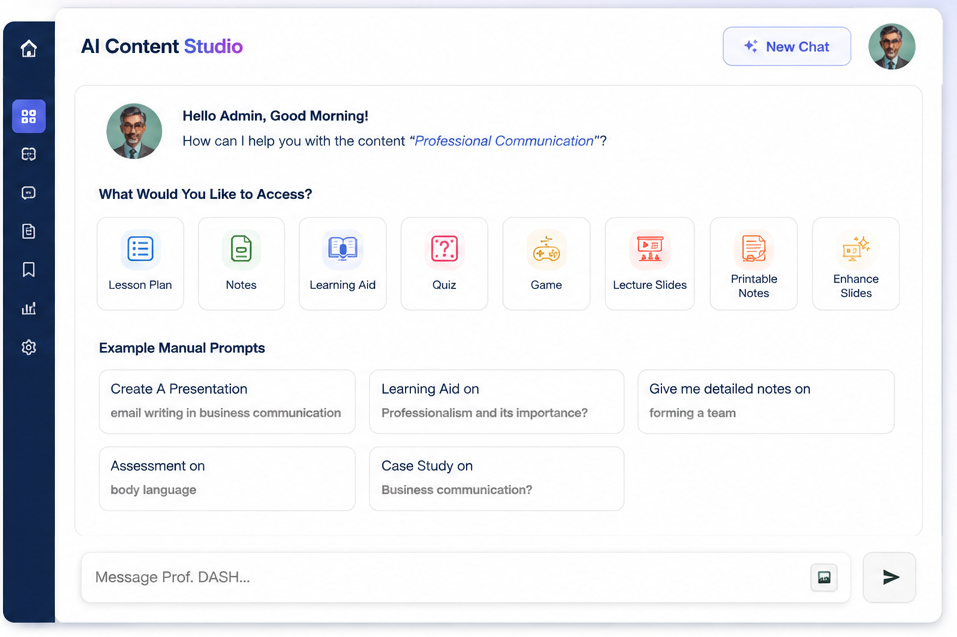
Source-grounded creationNotes · Presentations · Questions · Learning aids
Faculty-led AI evaluation
Evaluate more consistently.
Keep judgement human.
DASH AI helps faculty work through high-volume evaluation while preserving the rubric, source context and the academic reviewer’s final authority.
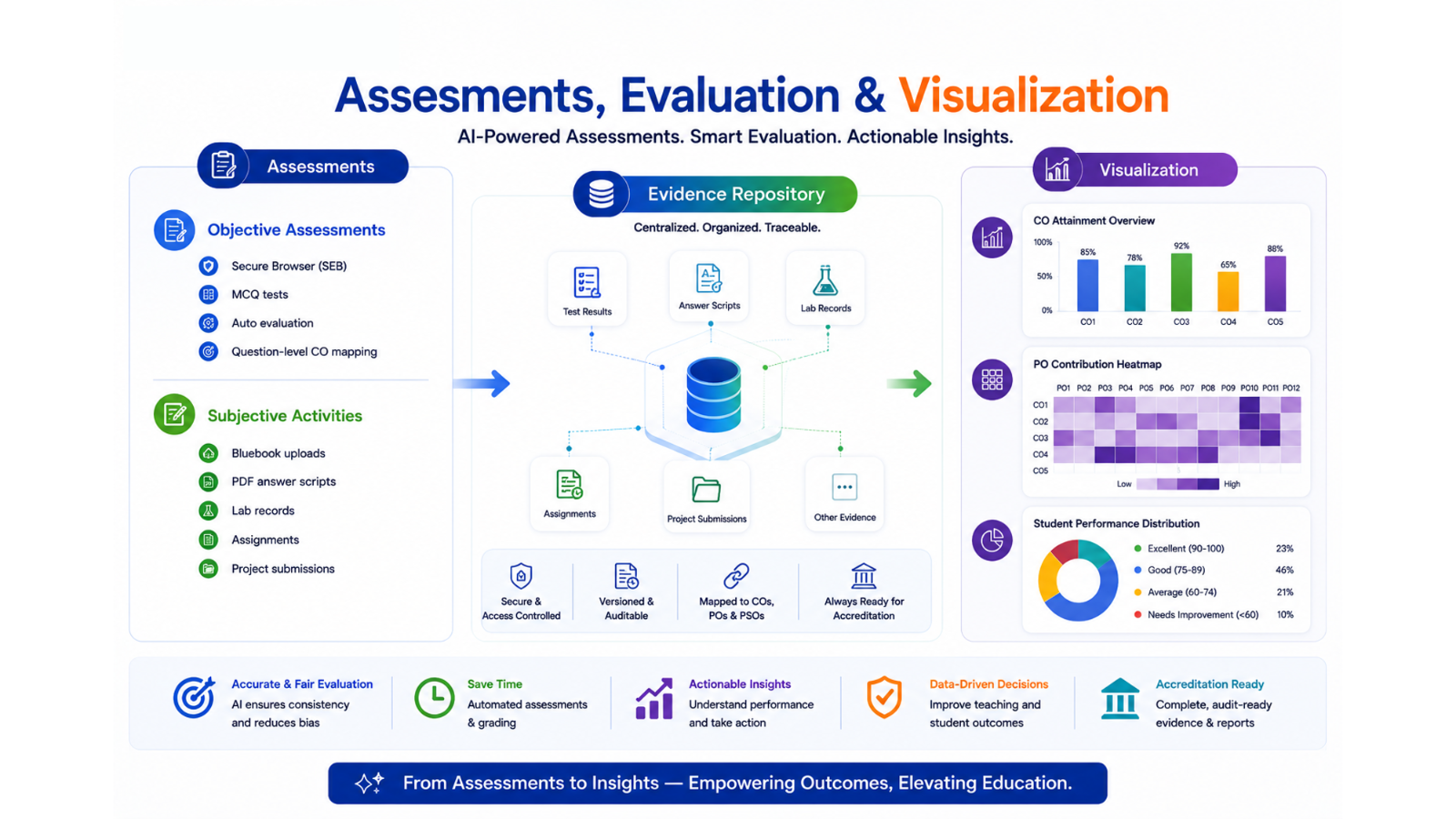
Objective + subjective
Bring tests, descriptive answers, assignments, projects, practicals and uploaded work into one evidence trail.
Rubric and source aware
Evaluate against defined criteria and approved learning material, with CO-level context carried into the review.
Feedback learners can use
Reveal concept gaps and connect each response to a targeted next learning action.
Faculty remains accountable
Suggestions are reviewable and editable. Faculty approves the final score, feedback and outcome evidence.
Accreditation support
NBA and NAAC: two lenses, one reliable evidence spine.
TriByte helps institutions make the underlying learning process visible and traceable. It supports accreditation preparation; governance, interpretation and compliance remain with the institution.
Programme lens
Demonstrate outcomes and continuous improvement
NBA accredits technical programmes and uses outcome-based criteria. The evidence story connects curriculum, teaching-learning, assessment, attainment and action taken.
- Outcome-based curriculum and teaching-learning
- CO, PO and PSO attainment evidence
- Assessment quality and traceability
- Documented continuous improvement
COsAssessmentShared
evidence
spineAttainmentImprovement
evidence
spineAttainmentImprovement
Institution lens
Show how learning quality is planned and improved
NAAC’s institutional quality lens includes teaching-learning, evaluation, student performance and learning outcomes. Consistent course-level evidence strengthens the larger institutional narrative.
- Published programme and course outcomes
- Outcome integration with assessment
- Student performance and learning evidence
- Quality review across programmes and cycles
Traceable by design
Move from scattered files to a living evidence system.
Every outcome, mapping, question, rubric, response, score, calculation and action can remain connected to its source and owner.
Version historyRole-based reviewCourse-to-programme roll-upExportable evidenceCycle comparisonsAction-plan ownership
Evidence lineageCO3 · Data Structures
Complete- Defined inCourse syllabus · v3.2Approved by BoS · 12 Jul
- Assessed throughAssignment 03 · Q4Rubric R-DS-04 · 32 responses
- Attainment2.6 / 3.0 · Target metDirect 80% · Indirect 20%
- Action recordedReinforce graph applicationsOwner Dr Rao · Review Sep
How TriByte helps the journey
Adopt OBE course by course—without losing institutional consistency.
Start from your current framework and maturity. TriByte helps configure the workflow, enable faculty, run the cycle and turn the results into a repeatable practice.
- 01Discover
Map the current process
Understand programme structures, attainment methods, systems, gaps and evidence owners.
- 02Configure
Set the OBE framework
Configure outcomes, mappings, targets, formulas, roles, rubrics and approval pathways.
- 03Enable
Prepare faculty
Use guided workflows, templates and workshops to make outcome alignment practical.
- 04Run
Capture evidence daily
Teach, assess, evaluate and intervene inside the connected learning workflow.
- 05Improve
Review and close the loop
Analyse attainment, document action and carry learning into the next cycle.
Built for real delivery conditionsWeb + mobileOnline + offlineMultilingualLive + blended + self-paced
See your OBE workflow in TriByte
Make every outcome easier to teach, measure and improve.
Bring one programme, one course or your current attainment process. We’ll show you how the complete evidence chain fits together.
Book an OBE demo